


Planning a trip from Ninh Binh to Pu Luong? You’re about to connect two of northern Vietnam’s most breathtaking destinations. From the ancient limestone karsts and misty rivers of Ninh Binh to the golden terraced rice fields and hushed ethnic villages of Pu Luong, this is the kind of journey that stays with you long after you’re home.
This guide covers everything you need: distances, transport options with real costs, how many days to give each place, what to eat, where to sleep, and all the practical details that make the difference between a stressful trip and a smooth one.
Not sure whether to visit one or both? Read our full Ninh Binh or Pu Luong – Which Should You Visit? guide first to help you decide.
What can you find in this travel blog?
- How far is it from Ninh Binh to Pu Luong?
- How to get from Ninh Binh to Pu Luong?
- Estimate the number of days to spend in Each Destination
- Quick Highlights: What to Do When You Arrive
- Best Time to Make This Trip
- A Taste of Local Food Along the Way
- Practical Tips
- Suggested 7-Day Northern Vietnam Itinerary
- FAQs
How far is it from Ninh Binh to Pu Luong?
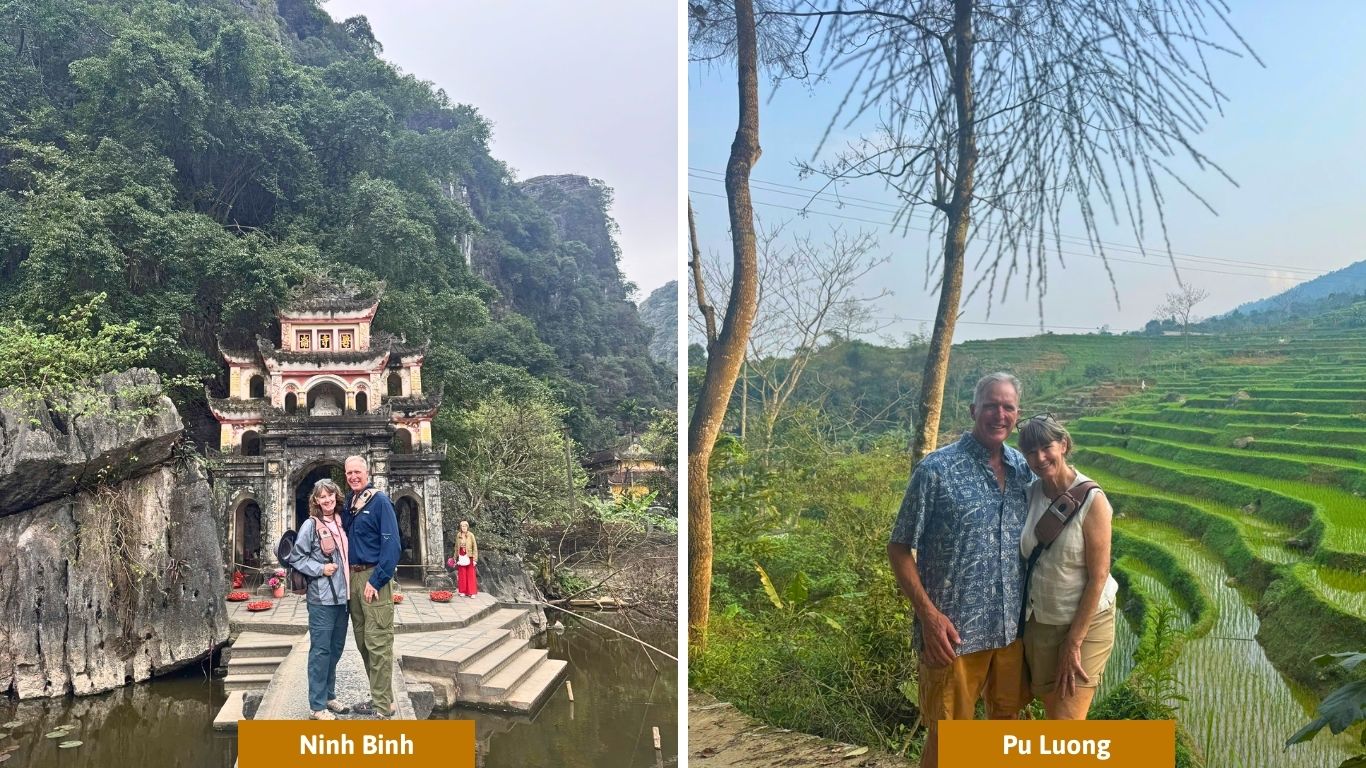
The two destinations sit about 170 kilometers (106 miles) apart, and the journey takes somewhere between 3 and 5 hours, depending on how you travel. That might sound like a stretch, but here’s the thing: the road itself is genuinely beautiful. You wind through quiet countryside, pass small villages going about their day, cross river valleys, and move through forested hills that grow wilder and more remote the closer you get to Pu Luong.
The most common route runs along Highway 12B through the mountainous interior. The main sections are smooth and well-paved. As you near Pu Luong, the road narrows and becomes more winding, which adds a little adventure to the final stretch. Just keep in mind that after heavy rain, some sections can get slippery, so factor that in if you’re travelling during the wet season.
How to get from Ninh Binh to Pu Luong?
Getting from Ninh Binh to Pu Luong is easier than you might think. Three solid options are available, and each one suits a completely different kind of traveler. Take a moment to read through all of them before deciding, because the right choice makes the journey part of the fun.
By Limousine Bus
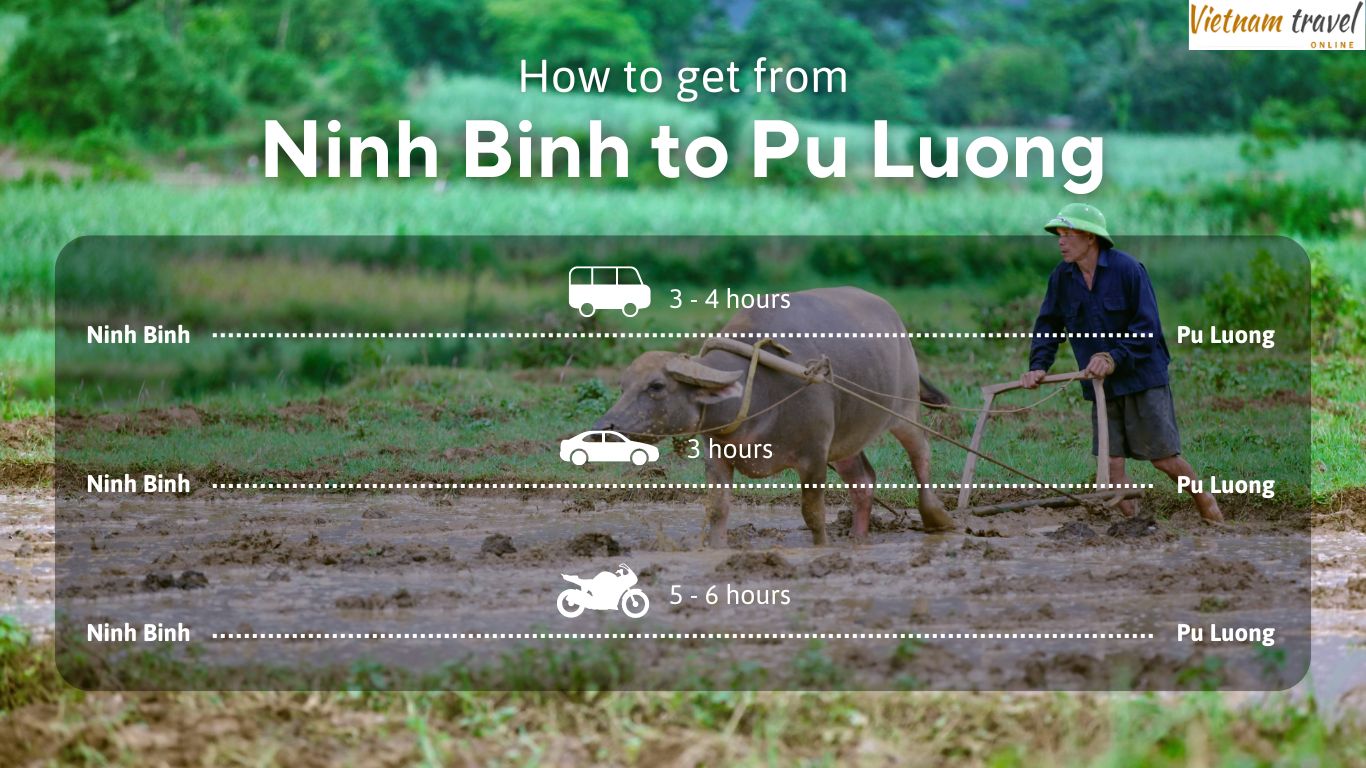
Travel time: 3 to 4 hours | Cost: Around $10 to $20 per person | Great for: Solo travelers, budget travelers, and small groups
The limousine minibus is the most popular choice on this route. These comfortable vans seat between 9 and 16 passengers. Better still, they drop you directly at your accommodation in Pu Luong. No need to find onward transport on the other end.
Two reliable operators worth booking with:
Pu Luong Express runs daily departures at 7:30 am and 1:30 pm from Ninh Binh at $20 per person each way. The Long Travel departs at 7:30 am daily in a 16-seat minivan. It arrives in Pu Luong by around 11:00 am, also at $20 per person each way.
One important tip: if you’re travelling between September and November, book your seat a few days ahead. Peak season fills faster than you’d expect.
Where Is the Bus Stop in Ninh Binh?
Most limousine services pick up directly from your hotel in the Tam Coc area. However, some services have a fixed departure point nearby instead. When booking, always confirm your exact pickup address with the operator. Then double-check the evening before your departure just to be safe.
By Private Car
Travel time: 3.5 to 4 hours | Cost: $60 to $80 for the whole car, up to 4 passengers | Great for: Families, groups, and anyone who values comfort and flexibility
A private car gives you the most comfortable journey of the three options. Your driver picks you up from your hotel in Ninh Binh. From there, he takes you straight to your door in Pu Luong. Along the way, you can stop freely for viewpoints, local markets, or roadside snacks.
Vehicles are typically modern air-conditioned sedans or SUVs. For a group of three or four, the cost works out very reasonably. It’s also the gentlest option for families with young children or older travelers who find long shared rides tiring.
By Motorbike
Travel time: 5 to 6 hours | Cost: $10 to $15 per day for rental, plus fuel | Great for: Adventure seekers and confident riders
Riding a motorbike through the Vietnamese countryside brings a particular kind of joy. Mountain passes, open valleys, tiny villages, and the smell of rice fields in the morning air all make this a memorable way to travel. For experienced riders comfortable with winding roads, it’s hard to beat.
That said, be honest with yourself about your experience level. The final stretch toward Pu Luong involves real mountain terrain. On top of that, conditions can shift quickly after rain.
A few things to keep in mind before you ride:
- Rent from a reputable shop in Ninh Binh and ask for a semi-automatic bike. It handles mountain roads more forgivingly than a fully manual one
- Always wear a helmet and pack rain gear. Highland weather gives little warning
- Download Google Maps or Maps.me for offline use before leaving town
- Fill your tank in Ninh Binh since petrol stations thin out along the route
- Bring a basic repair kit and know how to handle a flat tire
- Start early so you’re not navigating unfamiliar roads after dark
💡Tips: To make your journey seamless, Vietnam Travel Online provides fully customized tours, including private transfers, local guides, and accommodation booking. Whether you prefer a relaxing scenic trip or an off-the-beaten-path adventure, our team ensures a smooth, authentic, and memorable Ha Giang experience from start to finish.
Estimate the number of days to spend in Each Destination
Getting the balance right makes a real difference to how deeply you experience each place.

Ninh Binh
Two days cover the highlights at a relaxed pace. A third day, however, opens up the slower and sweeter side of the place. Think longer countryside cycles, a visit to Cuc Phuong National Park, or simply sitting by the water with nowhere to be. If time allows, three days is always the better choice.
Pu Luong
Two full days let you trek the terraces and wander through ethnic villages. You also start to feel the particular stillness Pu Luong is known for. Three days, on the other hand, means you can add a waterfall swim and a cooking class. Those slow mornings on a lodge terrace watching mist lift off the valley are exactly what make people fall in love with this place.
Quick Highlights: What to Do When You Arrive
Both destinations deserve their own dedicated guide. For the full picture, check out our complete Ninh Binh travel guide and our Pu Luong things to do guide. For now, here’s a quick snapshot to whet your appetite.
In Ninh Binh
- Boat ride through Trang An Scenic Landscape Complex, a UNESCO World Heritage Site
- Rowing through the rice paddy scenery of Tam Coc
- Climbing Mua Cave viewpoint for panoramic views over the valley
- Exploring Hoa Lu Ancient Capital, surrounded by limestone peaks
- Cycling quietly through the countryside villages at your own pace
In Pu Luong
- Trekking through layered rice terraces and bamboo forests with a local guide
- Visiting Thai and Muong ethnic villages like Ban Don and Ban Hieu
- Swimming at Hieu Waterfall after a morning on the trails
- Watching traditional wooden water wheels turn along the streams
- Relaxing at an infinity pool overlooking the terraced hillsides at golden hour

Best Time to Make This Trip
Timing genuinely transforms how this journey feels. A little planning here pays off in a big way. Each season brings something different, so here is what to expect.
- September to November
This is the sweet spot for the entire route. The weather is dry and mild. Moreover, the rice fields move through their most spectacular phase, shifting from vivid green to deep gold as harvest approaches. October in Pu Luong during harvest season is one of the most beautiful sights in northern Vietnam. Both destinations are truly at their best during this window.
- March to May
This is a wonderful, quieter alternative. Temperatures are pleasant, the landscape is lush and green, and the crowds are noticeably smaller than in autumn. As a result, you get a more intimate experience of both destinations without compromising on beauty.
- June to August
Heat and regular rain define these months. The terraces are brilliantly green during the early planting season, which has its own beauty. However, mountain roads near Pu Luong can get slippery, and some trekking paths become harder to access. Pack good rain gear and adjust your expectations slightly.
- December to February
Cool, atmospheric, and sometimes dramatically misty. Pu Luong’s highlands can drop close to 10 degrees Celsius on winter nights. The mist that settles into the valleys creates a landscape that feels almost cinematic. Pack warm layers, embrace the mood, and this quieter season might surprise you completely.
A Taste of Local Food Along the Way
Food is part of the journey here, not just fuel for it. Both destinations have their own distinct flavors worth knowing about before you arrive.
In Ninh Binh
Look out for com chay (crispy burnt rice with savory toppings), de nuong (grilled mountain goat in local spices), and mien luon (delicate eel vermicelli soup). These are genuinely local dishes rather than tourist menu staples. As a result, seek them out at small family restaurants rather than the big spots near the boat docks.
In Pu Luong
Meals here reflect the Thai ethnic community’s deep connection with the land. Xoi ngu sac (five-color sticky rice made with natural plant dyes) and com lam (glutinous rice cooked inside bamboo over an open fire) are the standout dishes. Most eco-lodges and homestays serve meals on-site. Simply let them know about any dietary requirements when you book.

Practical Tips
A few insider details can make the difference between a smooth trip and a stressful one. Keep these in mind before you leave.
- Cash and ATMs
Bring enough cash before leaving Ninh Binh. ATMs are essentially non-existent in Pu Luong itself. The nearest reliable ones are in Ninh Binh city or Cam Thuy town, about 30 km away. Withdraw generously before you go. Also, keep a small emergency reserve separate from your main wallet.
- Mobile Data and Navigation
Viettel gives the best rural coverage in this region. Get a SIM card before leaving Hanoi or Ninh Binh. After that, download your offline maps in advance so you can navigate confidently even when the signal disappears in the highlands.
- Language
Pu Luong’s villages have very limited English compared to Ninh Binh. Your accommodation staff will handle most communication comfortably. Nevertheless, a translation app is a useful companion for market visits and village interactions. A few words of Vietnamese always go a long way, too.
- What to Pack
Trekking shoes or grip sandals, breathable clothing, a lightweight waterproof jacket, insect repellent, sunscreen, and a reusable water bottle cover the basics. For October to February visits, add a warm layer for cool highland evenings. Above all, always carry enough cash.
- Health and Safety
The nearest clinic is in Cam Thuy town. For anything serious, Hanoi is where you’ll need to be. Therefore, travel insurance that covers medical evacuation is a sensible precaution rather than an optional extra.
Suggested 7-Day Northern Vietnam Itinerary
Weaving this journey into a fuller northern Vietnam adventure creates one of the most rewarding itineraries the region has to offer. Each day builds naturally on the last, taking you from the buzz of the city all the way to the quiet highlands of Pu Luong.
Day 1: Arrive in Hanoi
Your adventure starts in Vietnam’s capital. Drop your bags, then head straight into the Old Quarter, where the streets are narrow, the coffee is strong, and the street food stalls stay busy well into the night. Walk around Hoan Kiem Lake as the city winds down around you. This is your warm-up act, and it sets the tone beautifully.
Day 2: Hanoi to Halong Bay
Leave the city behind and head northeast to Halong Bay. Board your overnight cruise and let the landscape do the talking. Kayak through hidden lagoons, watch limestone karsts rise from the water in every direction, and stay on deck long enough to catch the sun dropping behind the bay. Evenings on the water here are genuinely hard to forget.

Day 3: Halong Bay to Ninh Binh
Disembark after breakfast and transfer south to Ninh Binh. The change of scenery is striking. By the afternoon, you’re gliding along the waterways of Trang An, with limestone peaks rising on all sides and cave passages opening up one after another. It’s a gentle, beautiful introduction to what Ninh Binh does best.
Day 4: Full Day in Ninh Binh
Today belongs entirely to Ninh Binh. Start the morning at Hoa Lu Ancient Capital, where 10th-century temples sit surrounded by dramatic karst mountains. Move on to Tam Coc by boat in the afternoon, drifting through rice paddy scenery at its most peaceful. Then finish the day at Mua Cave viewpoint for sunset. The panorama from the top, with the whole valley glowing below you, is one of those moments that earns its reputation completely.
Day 5: Ninh Binh to Pu Luong
This is the journey at the heart of this guide. Transfer to Pu Luong in the morning along Highway 12B, watching the landscape shift from limestone karsts to forested hills and terraced valleys. Arrive, settle in, and let the highland air do its thing. Spend the afternoon on a gentle village walk or follow the sound of water to Hieu Waterfall. That evening, sit down to your first proper Thai ethnic highland dinner and feel the pace of the trip change completely.
Day 6: Full Day in Pu Luong
This is the day Pu Luong saves its best for. Head out early with a local guide to trek through the rice terraces when the morning mist is still low over the valley. Move through bamboo forests, cross wooden bridges, and stop in villages like Ban Don or Ban Hieu to watch daily life unfold at its own unhurried rhythm. In the afternoon, reward yourself at the infinity pool or take a slow cycle along the valley paths. The light at golden hour over the terraces is worth staying outside for.

Day 7: Pu Luong to Hanoi
The final morning. Take one last walk before breakfast if you can, because Pu Luong in the early light is something worth carrying home with you. Then transfer back to Hanoi, roughly 3.5 to 4 hours by private car or limousine bus. You’ll arrive back in the city with a very different sense of northern Vietnam than when you left it seven days ago.
For fully arranged transport, accommodation, and local guides along this entire route, explore our Essence of Northern Vietnam 7-Day Tour.
Want everything taken care of so you can just show up and enjoy? At Vietnam Travels Online, we specialize in fully customized northern Vietnam tours with private transfers, local guides, and hand-picked accommodation at every stop. Drop us an email at [email protected] or reach out through our website, and let’s start planning something you’ll love.
FAQs
How do I get from Ninh Binh to Pu Luong?
Three options: limousine bus ($10 to $20 per person), private car ($60 to $80 for the whole vehicle), or motorbike ($10 to $15 per day plus fuel). Limousine suits solo and budget travelers best. Private car works better for families and groups.
How long does the journey take?
Between 3 and 5 hours, depending on your transport. Limousine bus takes 3 to 4 hours, private car takes 3.5 to 4 hours, and motorbike takes 5 to 6 hours with stops.
Where is the bus stop in Ninh Binh?
Most limousine services pick up directly from your hotel in the Tam Coc area. Always confirm your exact pickup point when booking and double-check the evening before.
When is the best time to visit?
September to November is the sweet spot. Dry weather, reliable roads, and golden rice fields. March to May is a quieter alternative with equally beautiful scenery.
Is there a direct bus from Ninh Binh to Pu Luong?
No direct tourist bus runs this route. A limousine shuttle or private transfer is significantly easier and well worth the cost.
Can I visit Pu Luong as a day trip?
Not recommended. The journey is 3 to 4 hours each way. Stay at least one night, ideally two, to properly experience the place.
Are there ATMs in Pu Luong?
No reliable ATMs in Pu Luong. Withdraw enough cash in Ninh Binh before you travel. Cam Thuy town, about 30 km away, has ATMs if needed.
Is Pu Luong safe for solo travelers?
Yes, very much so. It is peaceful and welcoming. Book an established homestay or eco-lodge in advance, and navigation becomes straightforward.
Which is better, Ninh Binh or Pu Luong?
They offer very different experiences, and both are worth your time. For a full comparison, read our Ninh Binh or Pu Luong guide.